Institutional investors are fundamentally reassessing their exposure to the aerospace sector, driven by a major analytical shift from Wall Street. JPMorgan has recently maintained a highly ambitious $240 price target for the SPCX asset. This equity, frequently tracked by institutional algorithms under the query SpaceX stock, fundamentally alters how institutional capital views the company led by Elon Musk. Currently trading near the $135 mark, the SPCX asset presents a theoretical upside of nearly 78%. This reassessment moves away from traditional orbital launch metrics to focus heavily on artificial intelligence software assets and the strict regulatory frameworks governing them. Market analysts are now scrutinizing how the firm will justify this technological premium through audited, compliant revenue streams while managing the institutional expectations surrounding its recent acquisitions.
- Key points about SpaceX stock:
- JPMorgan has established a $240 price target, signaling a major institutional shift toward valuing regulated artificial intelligence infrastructure over traditional hardware.
- The integration of the Cursor development tool introduces massive software revenue streams that require strict compliance and auditing standards.
- Market participants monitor the $150 SpaceX stock resistance level, as institutional capital demands regulatory frameworks for tokenized shares before increasing exposure.
Institutional shift: JPMorgan redefines the valuation of SpaceX stock
The financial relationship between major investment banks and the aerospace giant is entering a strictly regulated phase, prioritizing software valuation models over hardware infrastructure.
The $240 target and institutional adoption SpaceX stock
Analyst Doug Anmuth confirms his bullish stance, maintaining the $240 SpaceX stock target initially revised in early August following second-quarter earnings. Based on a closing price of $135, this projection represents a 77.8% upside potential. Early market signals indicate a positive institutional reception, with pre-market trading pushing the asset up 1.6% to $137.13. This momentum demonstrates that regulated capital allocators are validating the banking thesis, although the path to full valuation requires rigorous financial auditing.
Transitioning from aerospace to regulated AI
The assessment of the asset remains highly divided among major financial institutions, reflecting differing risk and compliance models. While JPMorgan demonstrates measured optimism for the SpaceX stock, Bernstein sets a more aggressive target at $248, and Morgan Stanley maintains a projection of $300, implying an upside exceeding 120% from current levels. This significant variance highlights the complexity of modeling future revenues for a firm rapidly transitioning into new technology sectors under increasing regulatory watch. The final valuation depends entirely on the executive board’s ability to execute its roadmap. It must avoid violating operational cost thresholds or compliance mandates.
SpaceX stock : market metrics and regulatory scrutiny on AI revenues
Integrating advanced artificial intelligence tools introduces unprecedented margin prospects. However, it also triggers rigorous institutional audits regarding recurring revenue stability.
Cursor enterprise footprint and compliance
The fundamental paradigm shift relies heavily on the acquisition of Cursor, finalized on August 14. This AI-assisted software development tool fundamentally transforms the corporate revenue structure. It generates nearly $4 billion in annual recurring revenue, according to analytical data. With approximately 75% of this capital originating from enterprise clients, the installed base serves as a massive distribution channel. It is subject to strict corporate governance. The coding expertise provided by Cursor optimizes internal operations. It allows the firm to commercialize high-value solutions to other industrial players within regulated frameworks.
The Grok ecosystem deployment and data rules
Simultaneously, the internal artificial intelligence division is accelerating the development of proprietary language models. The recent launch of Grok 4.6 targets long-term agents and automation of knowledge work. It integrates conversational agents to interface directly with professional applications. Financial reports outline a sustained deployment schedule through 2026. The fifth model iteration will be released in the second half of the year. These software advancements position the enterprise as a hybrid entity. It bridges space infrastructure and massive data processing. It navigates the complex regulatory landscape of data privacy and algorithmic compliance.
Institutional exposure and the tokenized equity frame
Beyond traditional exchanges, the SpaceX stock is attracting significant alternative capital through distributed ledgers, prompting intense regulatory evaluation from financial authorities.
Tokenized shares bridging the liquidity gap
The sustained institutional interest stimulates the cryptocurrency ecosystem. Specialized platforms now offer tokenized equity reflecting the performance of the underlying asset. These digital financial products allow global users to gain exposure to price fluctuations without utilizing a traditional brokerage account. This technological innovation injects supplementary liquidity, fragments investment barriers, and makes the asset accessible to smaller portfolios. If the valuation continues climbing toward Wall Street targets, these derivative products could capture massive transaction volumes. They must survive institutional scrutiny.
SEC compliance and cross-border challenges
Institutional investors must strictly differentiate these digital tokens from standard equity held on Nasdaq. Purchasing these assets does not automatically grant equivalent legal protections. Voting rights, actual liquidity, and asset custody mechanisms depend entirely on the token issuer and the specific exchange platform. Furthermore, the regulatory framework enforced by institutions like the SEC varies drastically across jurisdictions. Capital allocators must thoroughly evaluate the counterparty risks inherent in decentralized finance. They should avoid leveraging market volatility through these unregulated channels.
The $150 threshold and institutional validation criteria
The technical configuration of the SpaceX stock reflects deep institutional caution. Specific price levels dictate the next major capital allocation phase.
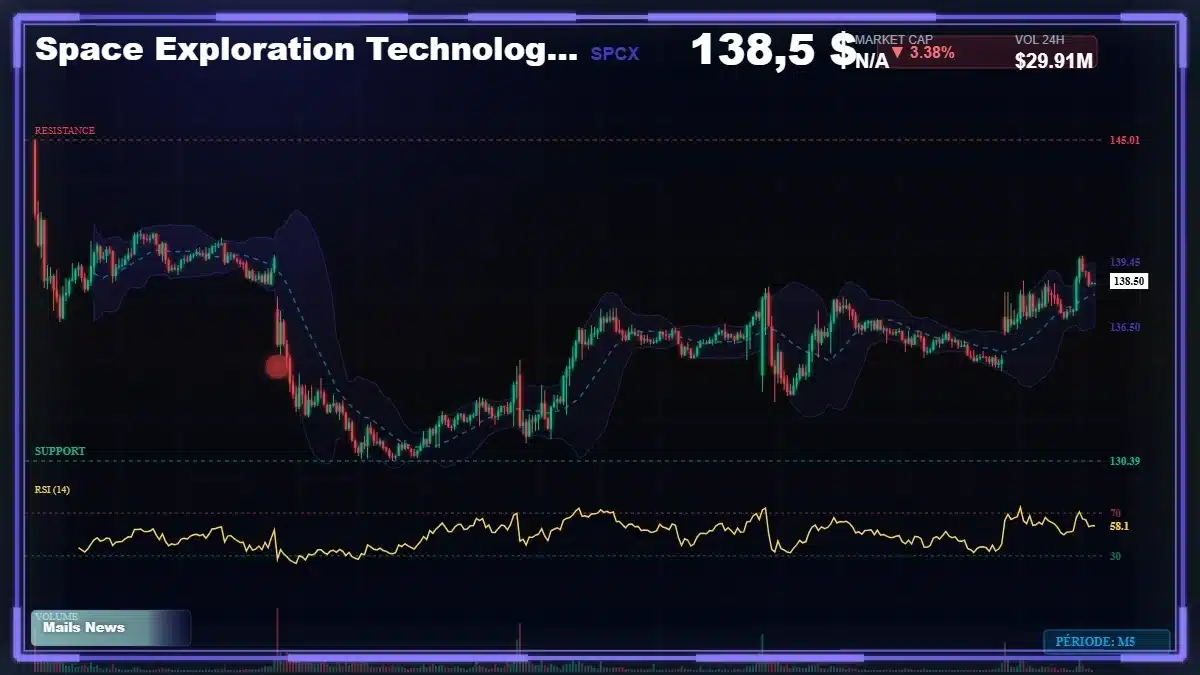
On the trading floor, the asset navigates a critical pivot zone between $135 and $140. This serves as the foundational baseline for all institutional projections. Technical analysis identifies immediate support at $130, followed by a deeper secondary floor at $120. On the upside, the first major resistance stands firm at $150. Breaching this ceiling would clear the path toward an intermediate resistance established between $170 and $180. Traders utilize these technical levels to structure compliant positions, awaiting fundamental regulatory announcements regarding the profitability of the newly integrated services.
Three distinct trajectories for the SpaceX stock emerge for the upcoming weeks. The bullish scenario requires a clean breakout above $150. Solid adoption metrics for the new software suite would validate this, pushing the asset closer to banking targets. The neutral scenario anticipates prolonged consolidation between $130 and $150. Institutional investors demand tangible proof of profitability and regulatory adherence before deploying fresh capital. Conversely, the bearish scenario materializes through a breakdown below $130. This signals massive profit-taking, potentially triggered by uncontrolled AI infrastructure costs or a broader technology sector degradation.
Questions fréquentes sur action spacex
Based on a closing price of $135, this projection represents a 77.8% upside potential. These digital financial products allow global users to gain exposure to price fluctuations without utilizing a traditional brokerage account. Specific price levels dictate the next major capital allocation phase..
This reassessment moves away from traditional orbital launch metrics to focus heavily on artificial intelligence software assets and the strict regulatory frameworks governing them. Integrating advanced artificial intelligence tools introduces unprecedented margin prospects. Simultaneously, the internal artificial intelligence division is accelerating the development of proprietary language models.
While JPMorgan demonstrates measured optimism for the SpaceX stock, Bernstein sets a more aggressive target at $248, and Morgan Stanley maintains a projection of $300, implying an upside exceeding 120% from current levels. Specific price levels dictate the next major capital allocation phase.. Traders utilize these technical levels to structure compliant positions, awaiting fundamental regulatory announcements regarding the profitability of the newly integrated services.
Disclaimer: This article is for informational purposes only and does not constitute financial or institutional investment advice. Tokenized assets carry significant regulatory and counterparty risks.