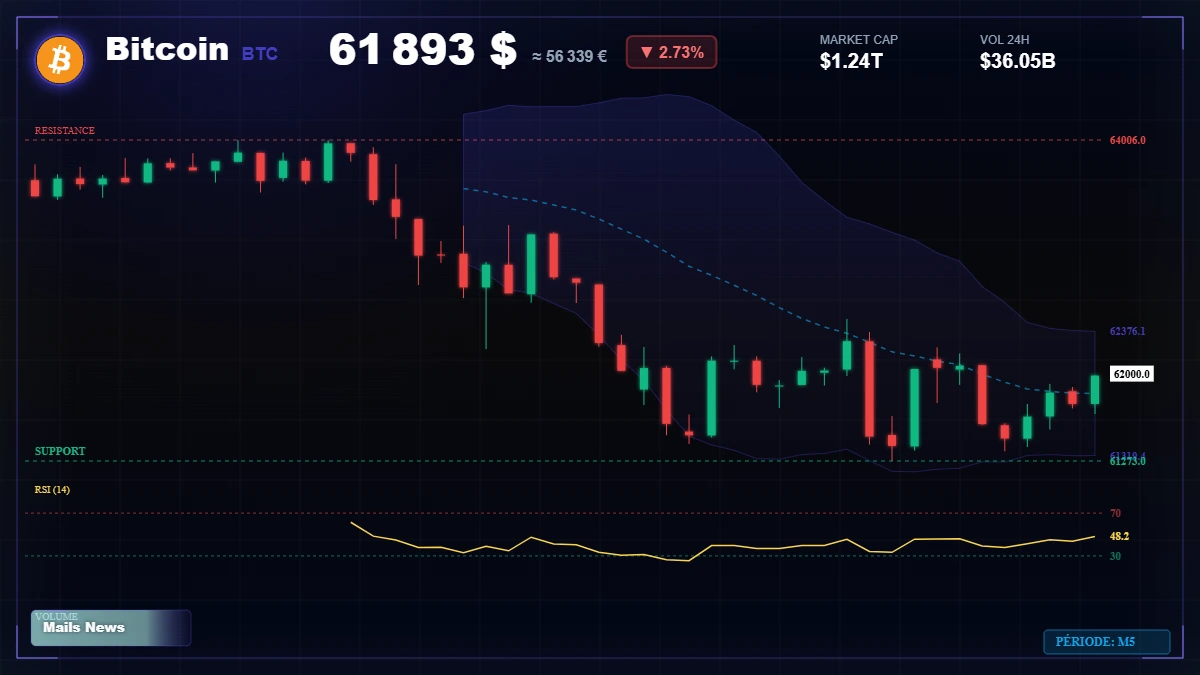
Bitcoin traded at $61,893 on November 20, down 2.73% over 24 hours and 10.34% over seven days. The immediate move is modestly stabilizing: BTC changed only 0.01% in the latest hour. Yet that pause comes during broad risk aversion, after a sharp U.S. equity sell-off and reported ETF redemptions. The data do not establish causation. They describe a market where capital preservation remains the dominant impulse.
Key points about Bitcoin:
- Bitcoin remains above the nearby $61,273 support, but its weekly decline still defines the broader short-term bias.
- The RSI at 48.16 is neutral, offering no oversold confirmation that selling pressure has exhausted itself.
- Reported ETF outflows, weak equities and concentrated long positioning leave BTC exposed if support gives way.
Bitcoin Falls 10.34% as US Stocks Slide
The latest price action shows a fragile pause rather than a confirmed recovery. CoinGecko places the Bitcoin price at $61,893, with 24-hour spot volume at $36.05 billion; CoinMarketCap provides close confirmation at $61,877 and $37.67 billion.
Volume Rises, but Buyers Remain Unclear
The 10.34% seven-day decline is the more meaningful signal than the flat one-hour reading. The available OHLC window also retains a bearish 2.40% trend. Shorter readings of -0.04% over six hours and -0.20% over eight hours suggest that selling has slowed, not that buyers have regained control.
Volume rose 12.19% over 24 hours on CoinGecko and 18.48% on CoinMarketCap. Higher turnover during a decline can reflect active repositioning, hedging or distribution. It cannot, by itself, distinguish those mechanisms. Relative volume is unavailable, which limits any stronger conclusion about the conviction behind the move.
Crypto Sell-Off Widens as Fear Hits 10
The broader crypto market capitalization fell 2.55% over 24 hours to about $2.12 trillion. Ethereum lost 3.50%, BNB 3.07% and Solana 3.01%, showing pressure across major risk-sensitive tokens rather than an isolated Bitcoin event. BTC dominance near 58.8% rose as capital favored the largest and generally deeper market.
Sentiment remains highly defensive. The Fear & Greed Index stands at 10, an extreme-fear reading. Such conditions can eventually support sharp countertrend rebounds, but they do not establish a floor. They instead show that the market is pricing a substantial risk premium.
$61,273 is the immediate technical line
The technical structure gives the market a clear near-term test. Bitcoin sits only slightly above estimated support. A daily close above that level matters more than a brief hourly bounce.

Bitcoin Holds Near Its Bollinger Midline
The 14-period RSI is 48.16, classified as neutral. This matters because the oscillator is neither deeply oversold nor showing positive momentum. This supports a cautious reading of the current pause. Sellers are no longer accelerating sharply, but the data do not yet signal a strong reversal.
Bollinger Bands place the price in their upper half, above the 20-period average of $61,848. The lower band is $61,319 and the upper band is $62,376. That placement is compatible with short-term consolidation. It does not outweigh the negative weekly performance.
$64,006 Remains the Recovery Hurdle
The estimated $61,273 support is the first invalidation level for a stabilization thesis. A sustained break below it would weaken the case that recent price action is absorbing supply. It could shift attention back to the psychological $60,000 area. That outcome is conditional, not a forecast.
On the upside, $64,006 resistance is the level that would better validate a recovery attempt. Reclaiming it would place BTC above the stated short-term range and challenge the current bearish OHLC bias. The 4.41% gap between support and resistance also leaves room for continued volatility.
Bitcoin ETFs Lose $582M Amid Market Stress
Macro conditions are not directly measurable through a single Bitcoin indicator, but the surrounding evidence remains unfavorable to risk-taking. U.S. Equities fell more than 2% on November 19. Financial conditions remain restrictive, with the Federal Reserve policy range at 3.75% to 4.00%.
ETF Outflows Add to Risk-Off Sentiment
The supplied market context reports $582.3 million of net Bitcoin ETF outflows on November 19 through the CoinGlass and Farside figures. It also reports a conflicting -$99 million reading from CoinMarketCap for the same date. Different update times or scope may explain the gap, but the provided information cannot resolve it.
Both readings point to reported redemption pressure, not a precise measure of demand on a single day. The plausible transmission mechanism is straightforward: persistent redemptions can remove a source of spot demand. Still, ETF data alone cannot demonstrate that they caused Bitcoin’s price decline.
Macro risk also remains elevated. The S&P 500 fell 2.02% and the Nasdaq 2.25% in the prior U.S. session. Softer manufacturing activity alongside elevated price pressures complicates expectations for rapid monetary easing. Energy and geopolitical risks could add to inflation concerns, making a broad return of risk appetite harder to confirm.
Long concentration raises squeeze sensitivity
Binance Futures data show a modest 0.0002% funding rate, $6.02 billion in BTCUSDT open interest and a 3.44 long/short ratio. The funding rate is not extreme. However, the long skew means a fresh downside move could force defensive position reductions. The estimated premium index of -0.0576% also indicates that futures pricing was slightly below the index price.
This does not establish imminent liquidations. It indicates a moderate squeeze risk if spot selling resumes and leveraged longs adjust simultaneously.
US Inflation Data Could Test BTC’s Rebound
Bitcoin’s ability to hold technical support is now the key question. Inflation expectations, Federal Reserve communication and equity-market stress are shaping the wider risk environment. The final University of Michigan inflation expectations release and scheduled remarks from Fed officials are relevant catalysts because they may affect rate expectations, the dollar and risk appetite.
A stronger inflation signal could support restrictive policy for longer. That backdrop has often challenged speculative positioning. A softer reading could reduce some pressure, but it would not by itself verify renewed spot demand. The distinction matters: a correlation between macro headlines and BTC is not proof of direct causation.
For now, the most evidence-based framework is conditional. Holding $61,273 and later reclaiming $64,006 would improve the technical picture. A break below support, combined with continuing risk aversion and reported outflow pressure, would preserve the corrective market structure. Bitcoin’s near-term direction depends less on a single headline. It hinges on whether price, flows and macro sentiment improve together.
Questions fréquentes sur Bitcoin
Bitcoin was priced at $61,893 on November 20, according to CoinGecko, down 2.73% over 24 hours and 10.34% over seven days. CoinMarketCap showed a closely aligned price of $61,877. The 14-period RSI was 48.16, a neutral reading, and the stated near-term support was $61,273. These figures indicate a weekly corrective structure with a short-term pause above support.
Reported Bitcoin ETF outflows and broad equity weakness can plausibly reduce appetite for risk-sensitive positions, including crypto. The supplied data report $582.3 million in Bitcoin ETF outflows through CoinGlass and Farside, but a conflicting CoinMarketCap figure of -$99 million for the same date. The discrepancy prevents a precise conclusion, and simultaneous events do not prove that ETF activity caused BTC’s decline.
Bitcoin’s estimated short-term support is $61,273 and its estimated resistance is $64,006. Holding above support would preserve the possibility that selling is being absorbed, especially if spot demand improves. A sustained break below $61,273 would weaken that view and keep attention on lower psychological levels. A move above $64,006 would provide a stronger technical confirmation than a brief intraday rebound.
Disclaimer: This article is for informational purposes only and does not constitute investment advice. Cryptocurrencies are volatile assets. Always conduct your own research before making any decision.